
Share capital and equity are often used as synonyms, but represent different concepts. Share capital is a specific equity item arising from contributions allocated to capital under company-law rules. Equity is a much broader measure: it includes capital, reserves, retained earnings or losses and the current year's result, alongside other items required by accounting rules. Confusion also arises because the two figures may coincide when a company is formed. If an S.r.l. is incorporated with 50,000 euros of capital and there are no other reserves or results yet, initial equity may indeed be 50,000 euros. From that moment, however, they begin moving differently.
Share capital is a constitutional figure
Share capital is the amount subscribed by shareholders and stated in the incorporation document, subject to subsequent amendments. It does not automatically change whenever the business makes a profit or loss. Changing it requires specific corporate decisions under the applicable rules. If a company with share capital of 50,000 euros earns a profit of 30,000 euros and retains it, share capital remains 50,000. Equity, however, may rise to 80,000 euros, simplifying and disregarding specific allocations.
Share capital is not money locked in a bank account
This is perhaps the most common misunderstanding. If a company is incorporated with 100,000 euros in paid-up capital, this does not mean it must forever keep 100,000 euros in cash in its current account. Those resources are used in the business: they may buy machinery, pay suppliers, finance inventory or cover other costs. After a few months, the company might have only 10,000 euros in the bank while still having share capital of 100,000 euros. Capital is an equity item, not a separate deposit of untouchable money.
Equity moves with results
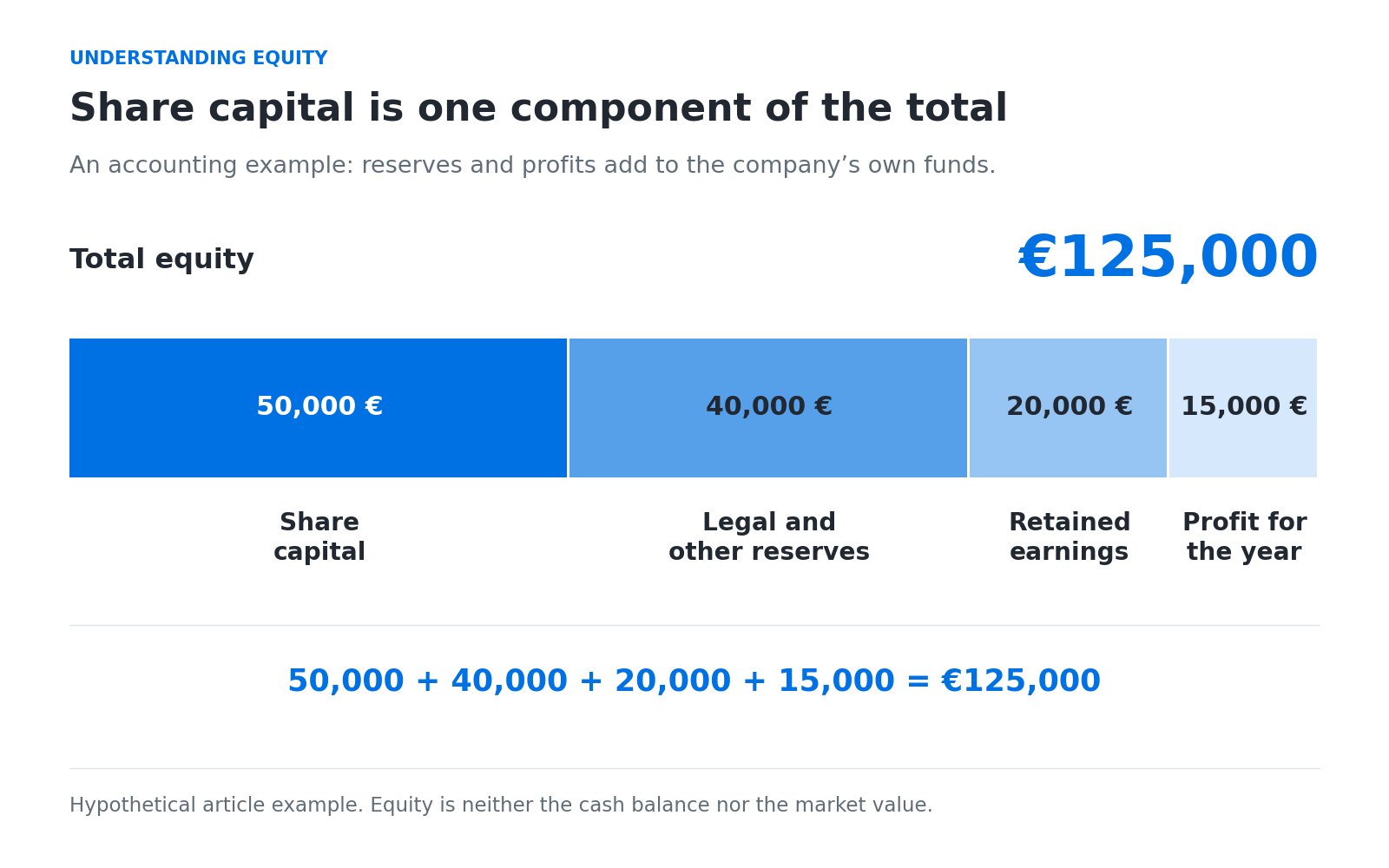
Imagine this position:
| Item | Amount |
|---|---|
| Share capital | 50,000 € |
| Legal reserve and other reserves | 40,000 € |
| Retained earnings | 20,000 € |
| Profit for the year | 15,000 € |
| Equity | 125,000 € |
Saying the company “has capital of 125,000 euros” would be inaccurate if we mean share capital. The company has share capital of 50,000 euros and equity of 125,000. Equity therefore represents the accounting value attributable to the company's own funds after considering components accumulated over time.
Following movements over the company's life
An effective way to distinguish the two measures is to observe what happens after incorporation. An S.r.l. starts with 50,000 euros in share capital. In its first year, it earns 20,000 euros and allocates 1,000 to the legal reserve, carrying the rest forward: capital remains 50,000, while equity rises. In the second year, it distributes some profits: equity falls, but capital does not change. In the third year, it incurs a loss: again, total equity is affected before the meeting potentially approves a formal capital change. This sequence shows that share capital is relatively stable and changes through specific corporate decisions; equity continually reflects profits, losses, distributions and contributions. Reading the financial statements therefore requires more than comparing capital with the bank balance. You need to reconstruct movements in individual items and understand which resources are distributable, which are restricted and which have already been absorbed by losses.
Losses can erode equity without immediately changing capital
Suppose the same company incurs a loss of 60,000 euros. Equity falls from 125,000 to 65,000 euros. Recorded share capital may formally remain 50,000, while reserves and accumulated profits absorb much of the loss. If losses grow and materially erode capital, the Civil Code rules on capital reduction for losses come into play. It is therefore important to distinguish the overall accounting measure from the specific corporate capital item.
A capital increase and an equity increase are not the same thing
When shareholders carry out a capital increase through new contributions, new resources enter the company and equity rises. But not everything increasing equity necessarily passes through share capital. Where correctly classified and accounted for, a shareholder may make contributions allocated to specific equity reserves; undistributed profits also build reserves without changing capital. Equity can therefore strengthen while share capital remains unchanged.
Equity and the company's market value
Equity does not necessarily equal the business's economic “worth” either. A company may have book equity of 1 million but a much higher economic value if it has a strong brand, recurring customers, technology or strong profit-generating capacity. It may also be worth less than book equity if assets generate poor returns or prospects are negative. Equity is therefore an essential accounting figure, but is not automatically the price a buyer would pay for the company.
Equity does not equal business value
A company with book equity of 300,000 euros may be worth much more if it has a profitable business, loyal customers, technology and growth prospects. It may also be worth less if assets are overstated or the business makes losses. Equity is an accounting measure constructed using financial-reporting criteria; economic value incorporates future cash flows, risk and market conditions. The distinction becomes crucial in capital increases and transfers of ownership interests. Contributing 100,000 euros does not automatically confer a percentage calculated solely on book equity: the pre-existing valuation and transaction terms must be established. Confusing share capital, equity and market value causes errors both in interpreting accounts and in negotiations between shareholders.
An example with three companies
Consider three businesses, each with share capital of 100,000 euros.
| Company A | Company B | Company C | |
|---|---|---|---|
| Share capital | 100,000 € | 100,000 € | 100,000 € |
| Reserves | 400,000 € | 20,000 € | 0 € |
| Accumulated profits/losses | 200,000 € | −80,000 € | −150,000 € |
| Equity | 700,000 € | 40,000 € | −50,000 € |
Saying they all have “100,000 euros in capital” is formally true if referring to share capital, but says almost nothing about their equity position. The first has accumulated substantial own funds, the second has already eroded much of its equity, and the third has negative equity.
Why the distinction is useful beyond accounting
Understanding the difference helps when reading financial statements, discussing dividends, assessing a loss, planning recapitalisation and analysing debt. A ratio such as financial debt/equity uses equity, not share capital. A company with 20,000 euros in capital but 2 million in reserves may have a much stronger equity position than another with share capital of 200,000 euros and equity almost wiped out by losses. The share-capital item therefore has a specific legal and organisational function, whereas equity tells the overall story of the business's own funds.
The simplest way to remember it
I would think of share capital as one line within equity. Equity is the container; share capital is one of its components. Retained profits can enlarge the container without changing that line, while losses can drastically reduce the total until action on capital itself becomes necessary. So when I hear “the company has net assets of 100,000 euros because it has 100,000 euros in share capital”, I would always check the accounts. Its equity could be much higher, much lower or even negative. Share capital describes how part of the company's own funds is formally structured; equity describes how much accounting equity remains overall at the reporting date.
Note. This article is for information and educational purposes only and does not constitute accounting, company-law or legal advice.